From batch to continuous tablet coating: a practical walkthrough with ACCELA CTC.
Introduction
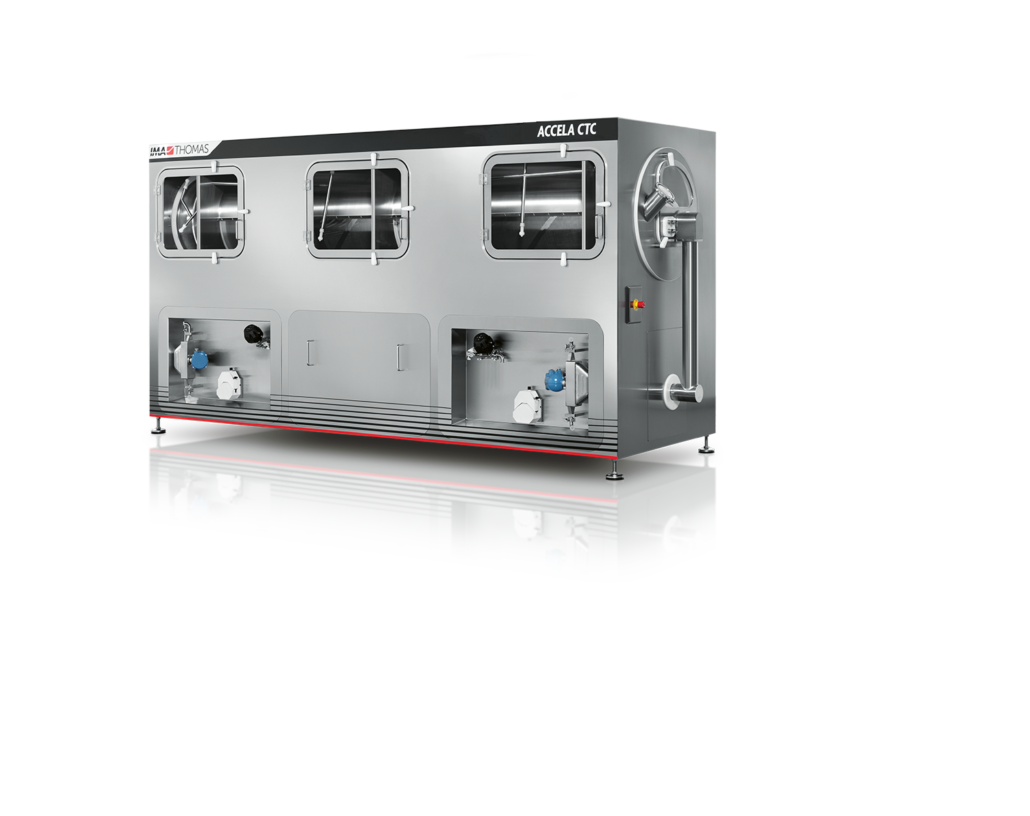
Continuous tablet coating replaces the existing stop and go routine of a batch coater with a single, steady state process-cutting handling steps, reducing documentation, and improving coating outcomes without altering product specifications. The ACCELA CTC platform embodies this shift through design choices that shorten residence time and provide a more robust process.
Establishing the foundations: process equivalence
Continuous and batch coating can be used interchangeably when the process environment is equivalent: inlet and outlet temperatures, spray rate, solution solids content, spray gun settings, and identical quality targets for weight gain, performance, and appearance.
When these conditions are aligned, any product that can be film coated in batch can also be film coated continuously, often with improved results.
Operationally, the difference is substantial. Batch coating multiplies non productive phases: loading, unloading, pre-heating, cooling, and repeated QA documentation per sub batch. Continuous coating consolidates everything into one uninterrupted process with one single end of run report, dramatically reducing handling and administrative work. Once startup is complete, coated tablets begin discharging continuously, around 500 kg/h in standard conditions, adding hours of effective production.
Why quality improves in continuous mode
Quality benefits arise from two fundamental physical differences between batch and continuous coating:
1. Shorter residence time
In batch, tablets tumble 2-3 hours at high heat, exposing them to mechanical erosion and prolonged thermal stress. In a continuous coater, the residence time falls to just 12-15 minutes, greatly reducing both abrasion and heat exposure, especially valuable for heat-sensitive APIs.
2. Shallower bed depth
A shallow bed means each tablet reaches the spray zone roughly every 30 seconds, compared to every 2-3 minutes in batch coaters.
This frequent presentation results in:
• Sharper edges
• Crisper embossing
• Faster and more uniform color development
| Batch coater | Continuous coater | |
| Tablets in spray zone | 1,080 | 3,000 |
| Drum speed | 5 rpm | 12 rpm |
| Rate of tablets through spray zone | 340,000/min | 905,000/min |
| Typical drum load | 350 kg (875,000 tablets) | 100 kg (250,000 tablets) |
| Average time between passes under the spray | 2.5 minutes | 0.25 minutes |
| Average number of passes | 13 | 35 |
| Coating applied per pass | 0.3 mg | 0.1 mg |
Table 1: frequency of tablet presentations to spray.
The shallow bed in ACCELA CTC enables gentle handling and more frequent spray passes; reduced spray per pass yields more uniform coatings in less time.
These dynamics also translate into efficiency gains. In a recent trial conducted at the IMA Thomas Competence Center, the same aesthetic result was achieved with 2.5% weight gain instead of 3%, reducing coating material consumption by approximately 15% while shortening process duration, all without compromising appearance.
Throughput and typical film parameters
At 15-20% solids and a target of 2.5-3% weight gain the ACCELA CTC 500 delivers an average throughput of ~540 kg/h.
As shown in Graph 1, if weight gain is reduced to 2.5%, throughput increases toward ~620 kg/h, a seemingly modest difference per hour that becomes significant over annual production volumes.
The ACCELA CTC platform offers a broad throughput range across the ACCELA CTC 500 and ACCELA CTC 1000.
• ACCELA CTC 500 runs from ~100 to 750 kg/h
• ACCELA CTC 1000 runs from ~200 to 1,200 kg/h
This flexibility allows each system to be tailored to specific product needs, whether low volume, high value pharmaceuticals or large volume nutraceutical production.
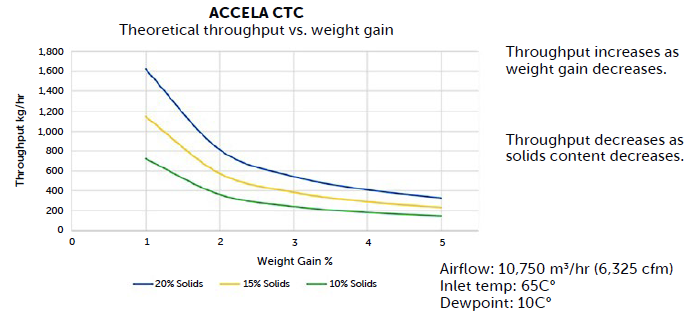
Graph 1: throughput at typical parameters.
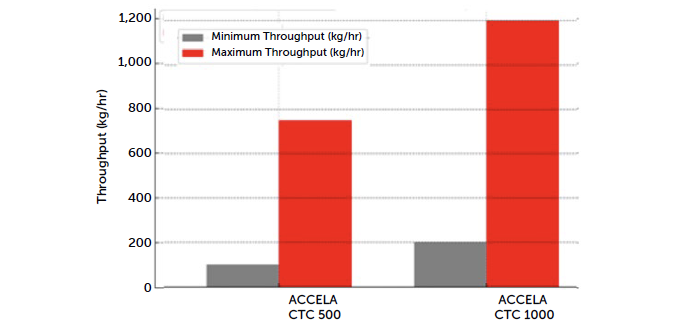
Graph 2: throughput range of CTC coaters.
Applications across pharmaceuticals and nutraceuticals
Continuous coating is established across a wide range of solid-dose applications, including:
• Antibiotics
• Diabetes medications
• Pain management
• OTC products
• Multivitamins
• Nutraceuticals
High-volume multivitamin manufacturers commonly operate at ~1,000 kg/h, 24 hours per day, six days per week. Only brief pauses, every four to six hours, for brushing the spray bar and guns are needed before production resumes.
Overall weight-gain capability spans ~0.5% for clear coatings up to ~7% for functional layers, with development underway toward ~12%. Sugar coating remains better suited to batch processes, although continuous functional coating continues to evolve.
Design features behind the performance
Optimised drum geometry
The 24-inch (610 mm) drum used across ACCELA CTC models maintains a shallow, well-mixed resident bed, typically 75-100 kg in the CTC 500. This geometry ensures frequent spray exposure, minimal compressive stress, reduced erosion, and a consistently high-quality finish.
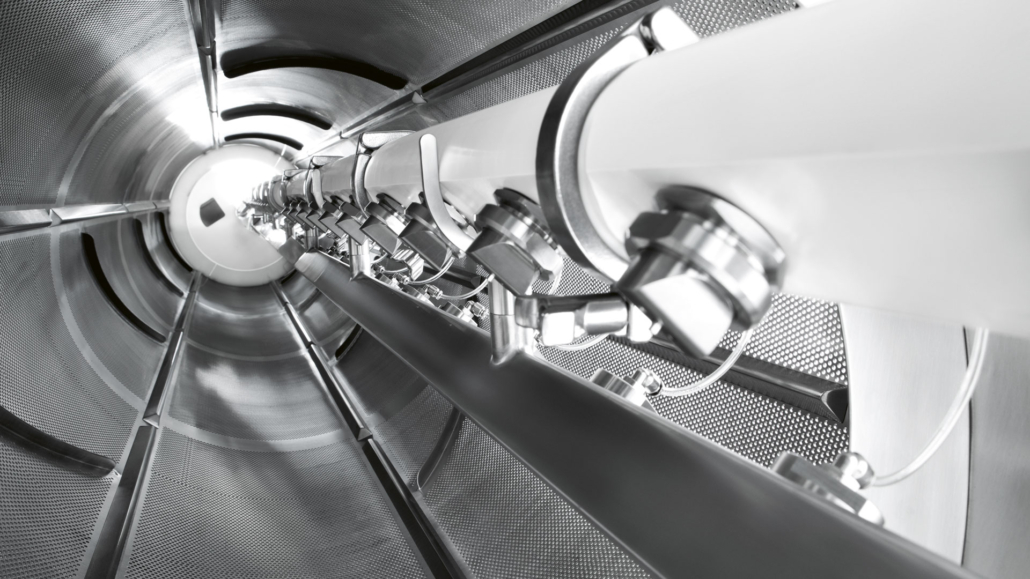
Patented Thomas Spray Bar®
All air and solution channels run inside the Thomas Spray Bar®, eliminating exposed lines that could disrupt airflow or trap tablets. This unique design:
• Keeps solution recirculating even during spray pauses
• Minimises cleaning and changeover time
• Reduces nozzle maintenance from ~45 minutes to ~5 minutes
• Lowers O ring count by ~25%, improving reliability and reducing maintenance needs
Integrated curing chamber
A dedicated curing section, standard across all ACCELA CTC models, performs final drying and film hardening within the continuous flow, removing the need for a separate post curing system. This reduces floorspace requirements, validation work, and operator workload.
Wash-In-Place
The coater drum and cabinet are fully covered by the automated WIP system; only the spray bar and internal gun components require manual cleaning. A spare spray bar can be installed in minutes via six quick connects, keeping downtime extremely low.
Process layout, control and material handling
The process path follows a clear and linear structure:
1. Hopper
2. Weigh belt driving throughput
3. Pre-heat section (first two guns idle)
4. Fully perforated spray zone
5. Discharge plate
6. Curing chamber
7. Discharge chute
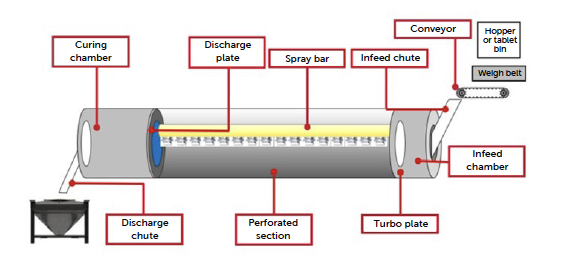
Figure 1: overall coater layout.
The weigh belt continuously measures throughput and maintains a cumulative total. When the recipe’s lot size is reached, the system initiates an automated, sequenced shutdown. Guns turn off in order while a bed is maintained in the drum, ensuring consistent weight gain through the final tablets.
Material handling configurations can be tailored to:
• IBC feed/discharge
• Buffer hoppers
• Automated container switching at predefined limits
• Multi floor layouts
Continuous coaters can also be integrated with tablet presses. A buffer hopper balances mass flow: the press stops on high level, the coater pauses on low level, ensuring perfect synchronization of powder in and coated tablets out. Future integration requires only updated sensors and communication interfaces—no hardware modifications to the coater.
Batch vs continuous coating: a production-scale case
To illustrate the practical difference between batch and continuous coating, let’s examine a real world case: a customer producing a 2,400 kg lot of coated tablets. We compare two approaches:
1. Traditional batch coating using a 60 inch coater with a 340 kg pan capacity.
2. Continuous coating using ACCELA CTC at ~400 kg/h throughput.
Batch coating workflow (7 pans to reach 2,400 kg)
With a 340 kg drum, reaching 2,400 kg requires seven separate loads. Each load repeats the same sequence:
• Loading the drum: 10 minutes
• Warm up to reach process temperature: 15 minutes
• Spray coating to achieve uniformity: ~130 minutes
• Cool down: 10 minutes
• Unloading: 15 minutes
• Changeover (move product out, stage new cores, complete paperwork): 60 minutes
• Total time per batch: 4 hours
• Time for the full 2,400 kg batch: 7 cycles × 4 hours each › almost 30 hours of processing
This represents almost one and a half production days for a single 2,400 kg lot.
It also produces seven separate batch records, seven sets of logs and QA documentation, and multiple hours of non productive handling.
Continuous coating workflow (one uninterrupted process)
The same 2,400 kg batch is coated in a single continuous run, without repeating the pre heat, cool down, loading, and documentation cycles.
• Initial warm up of the resident bed: 15 minutes
• Spray gun sequencing: 30 minutes
• Coating at steady state: just under 6 hours
• Shutdown and discharge: less than 1 hour
• Total time for the full 2,400 kg: < 8 hours
This is roughly 75% faster than batch coating, reducing a 30 hour process to a single shift operation.
Additionally, it produces one single report instead of seven, with far less QA and handling effort.
| Operations | Time |
| Loading drum | 10 minutes |
| Warm up | 15 minutes |
| Spray coating | 130 minutes |
| Cool down | 10 minutes |
| Unloading drum | 15 minutes |
| Changeover time | 60 minutes |
| Total time each batch | 4 hours |
| Coater batches | 7 at 340 kg each |
Table 2: operations in 60-inch batch coater.
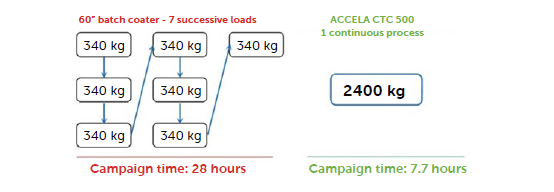
Graph 3: batch vs continuous coating: production time comparison for a 2,400 kg lot.
Conclusion
Continuous coating offers a robust set of advantages:
• Higher throughput and markedly reduced processing time
• Simplified workflows with a single end of run report
• Lower handling and QA burden
• Gentler mechanics and shorter exposure, improving coating quality
• Flexible, scalable performance for mid range to high volume operations
Combined with unified controls and remote assistance, the ACCELA CTC platform provides a practical, proven pathway for adopting continuous coating. Customers may send products for trials to define optimal parameters and predict achievable performance.